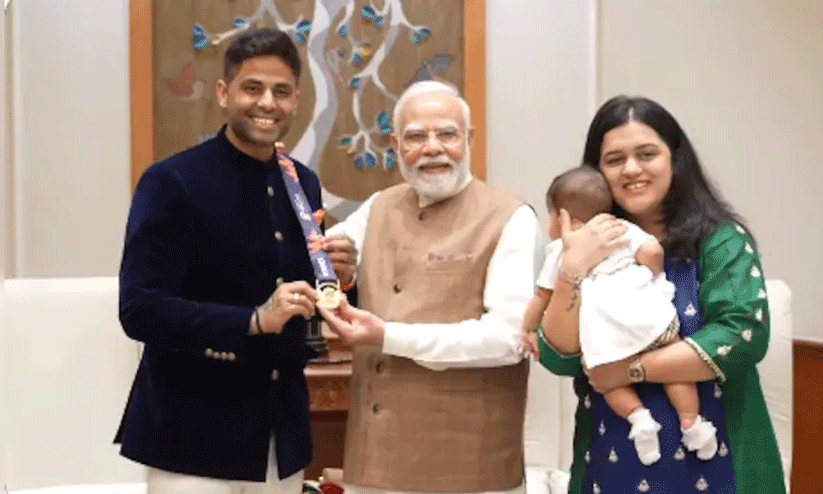
In the high-stakes theater of international cricket, the transition from dominance to doubt often happens with jarring speed. For Suryakumar Yadav, a man whose name became synonymous with the explosive evolution of the T20 format, the recent shifts in his professional trajectory have been nothing short of seismic. Yet, on November 6, 2026, the frantic pace of the pitch was replaced by the composed atmosphere of New Delhi, where Yadav met with Prime Minister Narendra Modi.

It was not merely a formal diplomatic encounter, but a personal one. Yadav arrived accompanied by his wife, Devisha Shetty, and his daughter, Ridhima. In the presence of the nation's leader, the conversation drifted from the geopolitical to the familial, as the Prime Minister interacted with Yadav's children. It was a moment that humanized a sporting icon, pulling him away from the statistics and the scrutiny of the scoreboard to stand as a father and a husband.
During the meeting, the centerpiece of the interaction was a tangible symbol of athletic excellence: the gold medal won during the 2026 T20 World Cup. As Yadav shared the medal with the Prime Minister, the object served as more than just metal; it was a testament to India's consecutive triumphs in the T20 World Cup, a period of dominance in which Yadav played a pivotal role.
Recently, the momentum that carried Yadav through consecutive World Cup victories has met a period of friction.
To understand the significance of that gold, one must look back at the sheer statistical gravity Yadav exerted over the game during his peak. He was not merely a participant in the sport; he was its standard-bearer. In 2022 and 2023, he was named the ICC Men's T20 Cricketer of the Year, a distinction that marked him as the premier talent in the shortest, most volatile format of the game.
There are moments in any career where the numbers transcend mere data and become historical markers. For Yadav, that moment arrived in January 2023. During that month, he achieved a career-high rating of 910 points in the T20 batting rankings. In the world of professional cricket, where rankings fluctuate with every boundary and every dismissal, reaching a 910-point threshold is a feat of sustained, overwhelming excellence.
This rating was the mathematical proof of what fans had seen on the field: a batsman capable of rewriting the geometry of the cricket pitch. It was the era of the 'Suryakumar era,' a time when his ability to manipulate bowlers seemed almost supernatural, cementing his status as a global phenomenon in the T20 circuit.
However, the ascent to such heights is rarely a permanent plateau. The very volatility that makes T20 cricket so captivating is also its most punishing element. Recently, the momentum that carried Yadav through consecutive World Cup victories has met a period of friction. A decline in batting form—the inevitable ebb in the tide of any high-performance athlete—has begun to reshape the landscape of the Indian national team.

This decline has had immediate consequences for his role within the squad. Yadav was recently excluded from the Indian T20 squad selected for the upcoming tour of the United Kingdom. In the unforgiving ecosystem of international sports, form dictates position, and the absence of that signature scoring power has opened the door for a new era of leadership.
With Yadav stepping aside, the mantle of leadership has transitioned. Shreyas Iyer has reportedly been appointed as the new T20 captain, signaling a strategic pivot for the Indian side. This change represents more than just a new name on the team sheet; it marks a structural reorganization as the team looks to navigate the challenges of the UK tour and beyond.
For Yadav, the transition is a complex one. To go from the captaincy and the ICC's highest individual honors to exclusion from a touring squad is a journey that few athletes navigate with grace. It is a reminder that in the world of elite sport, the distance between the pinnacle and the periphery can be remarkably thin.
Even amidst these professional shifts, the intersection of the Prime Minister and the cricketer provided moments of unexpected cultural warmth. Following their meeting, a video shared on social media by Prime Minister Modi captured a different kind of performance. The footage featured a young girl singing a Kannada devotional song dedicated to Lord Ganesha, with the Prime Minister seen appreciating the performance.
It was a brief, melodic interlude that stood in stark contrast to the high-pressure world of international cricket. For a player like Yadav, caught between the glory of a 2026 World Cup gold medal and the uncertainty of a changing squad, such moments of national connection offer a different kind of validation—one that exists outside the boundaries of the pitch and the relentless ticking of the ranking points.