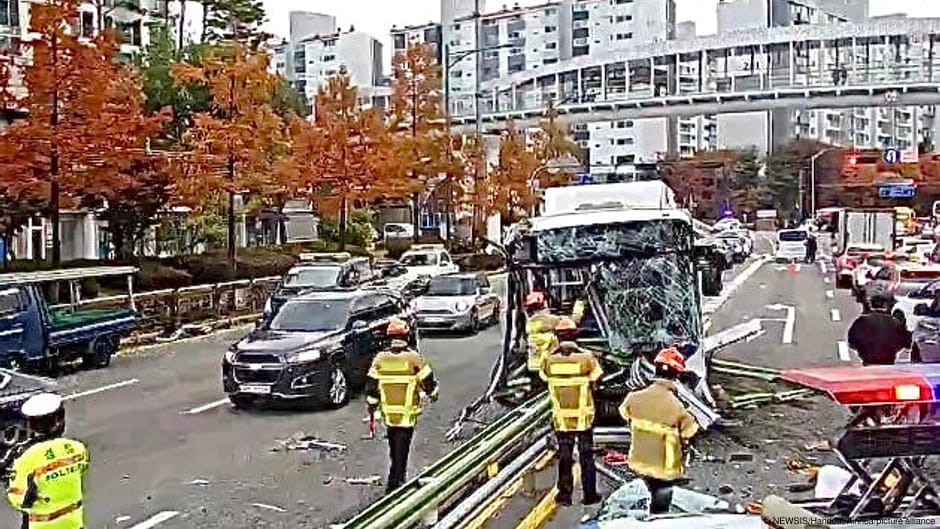
The smell of burnt rubber and shattered glass still hangs over the streets of Seongnam, a sprawling district just south of Seoul where thousands of commuters navigate the daily surge of traffic. For the morning of Wednesday, November 11, 2026, that routine movement was shattered by a single, horrifying mechanical event. A passenger bus, likely loaded with workers heading to the business district, did not simply slow down at a busy intersection; it failed to stop entirely. The result was a cascading collision that swallowed 32 other vehicles in a chaotic tangle of metal, leaving 57 people injured and one of the bus drivers claiming that the vehicle's brakes simply did not work.

Time is the crucial detail in understanding how such a disaster becomes possible. The accident struck early Wednesday morning at 7.34 local time. This is the peak of the morning rush, a period when intersections are already saturated with cars, buses, and pedestrians who rely on the strict discipline of traffic signals. Under normal conditions, a bus approaching a red light should engage its service brakes, decelerate smoothly, and come to a halt behind the line of waiting traffic. In this case, the physics of the crash suggest a complete loss of that control. The bus carried its momentum straight through the signal, striking 32 other vehicles as they waited at the light. The sheer number of cars involved—32 in total—indicates that the bus did not just clip a few leading cars; it penetrated the intersection's congestion, creating a chaotic scene that blocked a significant stretch of the road.
In the immediate aftermath, as paramedics rushed to the injured and police secured the perimeter, the narrative turned on the bus driver, a 60-year-old man. He was not just a witness to the crash; he was an active participant who survived to explain it. His statement was direct and urgent: the brakes of the bus did not work. For a commuter or a police officer listening, this is not a minor complaint. In commercial vehicle terms, a claim of total brake failure is an admission of a catastrophic mechanical defect. The driver’s words suggest that even if he reacted instantly, the vehicle’s mechanical systems had let him down. This shifts the focus from the driver's immediate actions to the vehicle's maintenance history and the engineering that failed him.
A critical first step in any commercial crash investigation is ruling out the human elements that often complicate blame.
Police did not take the driver's word for it; they launched an investigation to establish the exact causes and circumstances of the accident. A critical first step in any commercial crash investigation is ruling out the human elements that often complicate blame. Officers tested the driver and confirmed he was not under the influence of alcohol. This finding cleared one major variable, but it did not close the case. The authorities are now deepening their inquiry into potential medication or substance use that might have impaired the driver's reaction time, even in the absence of alcohol. The investigation is two-sided: it must verify if the mechanical brake failure was genuine or if the system was functional but the driver was unable to operate it safely.
The statistics of the crash are heavy, but behind them are individual stories of survival and trauma. In total, 57 people were injured in the event. The severity of the injuries varies, but the toll on the medical system is immediate and substantial. Nine individuals were reported to be in critical condition, a group that includes the most severely impacted victims, many likely trapped under the weight of vehicles or suffering from the sudden, high-speed impact. The presence of the 60-year-old driver among those involved in the crash is a poignant detail; the person who was at the wheel of the failing machine was also part of the chaotic scene, highlighting that mechanical failure is an indiscriminate hazard.
The accident did not just stop a bus; it stopped a significant artery of the local transport network. With the wreckage of the 32 vehicles and the bus blocking the intersection, traffic in Seongnam was inevitably disrupted. For a commuter district that relies on predictable rush-hour flow, a crash of this magnitude creates a ripple effect that extends well beyond the immediate intersection. Roads leading into the crash zone likely saw gridlock as drivers avoided the scene, and transit lines that rely on that stretch of road were forced to detour or halt. The physical cleanup of 33 vehicles—32 cars plus the bus—represents a logistical challenge that keeps the scene cordoned off and dangerous for hours after the initial crash.
There is a chilling element in the specific timing of 7:34 AM. Morning rush hour is when the risk of multi-vehicle pileups is highest, not just because of the density of traffic, but because of the driver psychology. Commuters are tired, focused on arriving on time, and often less attentive to the subtle delays that precede a signal change. If the bus had failed a minute earlier, or if the intersection had been slightly more empty, the outcome might have been less severe. The crash serves as a stark reminder that the safety of modern urban transit systems is only as strong as their weakest link. A single component, like the bus's brake system, failing at the worst possible time can turn a normal morning commute into a mass-casualty event.

As of Wednesday, the investigation into the 32-vehicle crash remains ongoing, with authorities focusing on whether the 60-year-old driver's claim of brake failure holds up against technical inspections and further toxicology reports. The 57 injured individuals continue to receive treatment, while the public awaits clarity on the exact mechanical conditions that allowed a commercial bus to plow through a red light and collide with so many waiting vehicles.