
Cockroach Janata Party: Revolution Begins with Class Consciousness


From insult to identity: the rise of a movement demanding fairness, opportunity, and accountability in India's examination system.
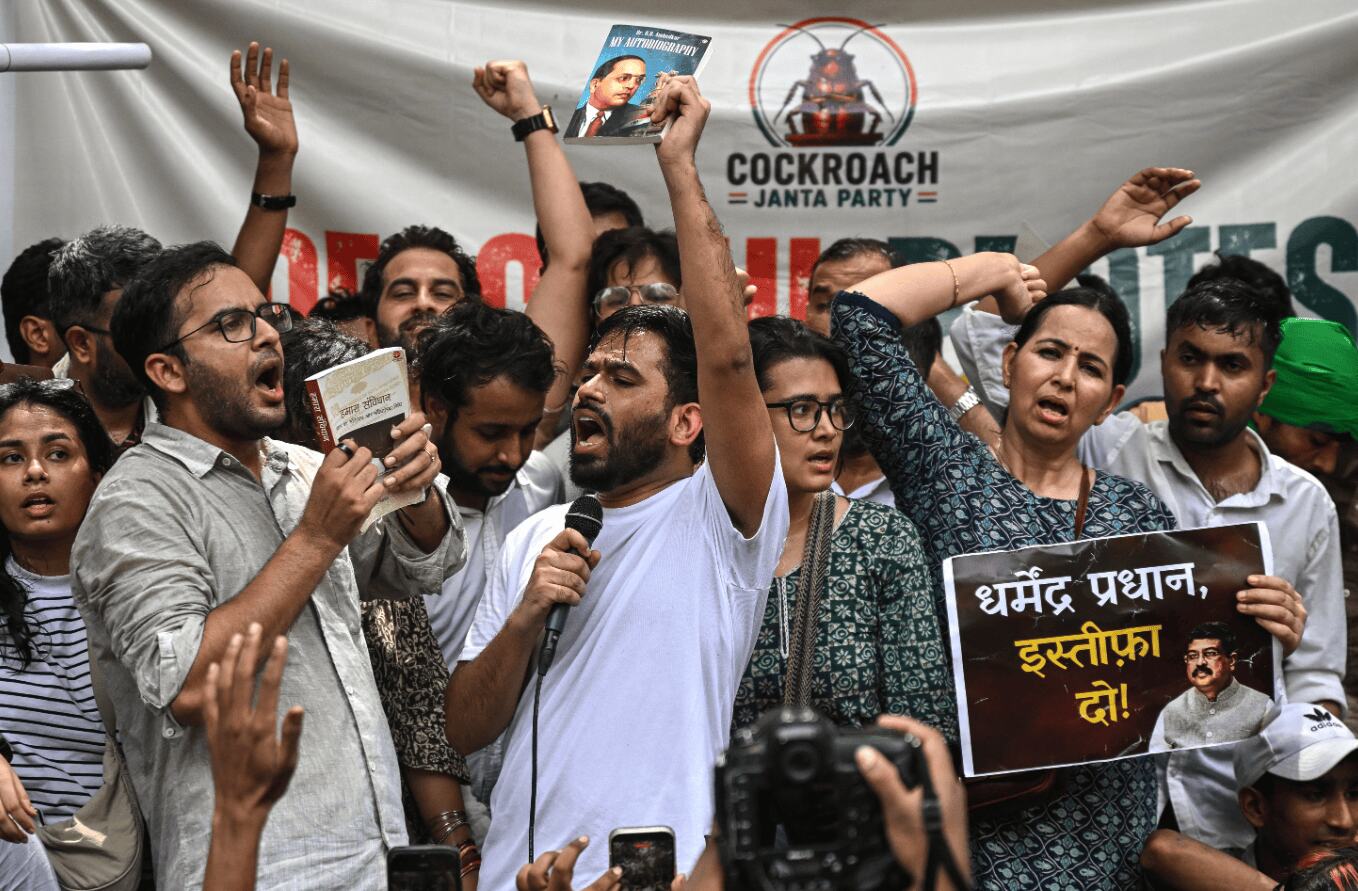
The Birth of an Unlikely Political Creature
The Cockroach Janata Party did not emerge from a manifesto, an election campaign, or the office of an ambitious politician.
It emerged from an insult.
Like many political movements before it, the Cockroach Janata Party (CJP) was born from a moment that revealed a deeper social wound. Revolutions often begin when a group of people suddenly recognize themselves in a shared experience of exclusion. The CJP's story is ultimately one about class consciousness, institutional failure, and a generation discovering its collective voice.
Its origin can be traced to a courtroom remark that spread rapidly across India's digital landscape. During judicial proceedings, comments attributed to former Chief Justice of India Justice Surya Kant comparing certain individuals to "cockroaches" triggered immediate outrage among students and unemployed youth already burdened by years of delayed examinations, cancelled recruitments, and shrinking opportunities.
Justice Surya Kant later clarified that his comments had been misunderstood and were intended to refer to individuals using fake educational credentials rather than struggling youth in general. But public language has a life of its own. Once released into the public sphere, the metaphor escaped its original context.
The word "cockroach" stopped being an insult.
It became an identity.
Reclaiming the Insult
The remarkable aspect of the Cockroach Janata Party is not that it was insulted. Political groups have long been ridiculed by opponents and institutions alike.
The remarkable aspect is what happened next.
Instead of rejecting the label, thousands of young people embraced it. What began as a perceived slight was transformed into a symbol of resistance. Social media users changed profile pictures, adopted the imagery, and began referring to themselves proudly as "cockroaches."
The symbolism was powerful.
The cockroach is among the most disliked creatures on earth, yet it possesses a reputation for extraordinary survival. It endures harsh environments, repeated attempts at eradication, and conditions that would destroy more fragile organisms.
For many students and job seekers, that image felt deeply familiar.
Years of preparation for competitive examinations had often been followed by paper leaks, cancellations, recruitment freezes, and endless delays. Their message became simple:
"Call us cockroaches if you wish. We are still here. We are still waiting. And now we are organising."
The insult had accidentally created a political identity.
From Hashtag to Organisation
Movements rarely survive on emotion alone.
Many online protests disappear as quickly as they emerge. What distinguished the Cockroach Janata Party was its transition from digital outrage into organised activism.
A central figure in that transformation was Abhijeet Dipke.
Coming from a communications and strategy background, Dipke understood that viral attention without structure often produces little lasting impact. Under his leadership, the movement developed an organisational framework, public messaging, and a coherent set of demands.
The CJP was no longer simply a reaction.
It became an actor.
Dipke provided strategic direction, while organisers such as Saurav Das expanded the movement's public presence through demonstrations, media engagement, and grassroots mobilisation.
Together they helped ensure that the Cockroach Janata Party would outlive the news cycle that created it.
The Arrival of Moral Legitimacy
Every movement eventually seeks legitimacy beyond its original constituency.
For the CJP, that moment arrived when social reformer and engineer Sonam Wangchuk publicly expressed solidarity with the movement.
Known nationally for his educational initiatives and advocacy for Ladakh, Wangchuk's support extended the movement's reach beyond examination candidates and unemployed youth.
When he appeared alongside protesters and jokingly referred to himself as an "honorary cockroach," the symbolism resonated nationally.
His involvement suggested that the movement's concerns were not merely about examinations. They reflected broader questions about institutional accountability, educational reform, and public trust.
The Cockroach Janata Party had begun as a grievance movement.
It was increasingly becoming a political conversation.
Discovering Ambedkar
As the movement matured, another figure began appearing alongside its banners and slogans.
That figure was B. R. Ambedkar.
At protests across India, portraits of Ambedkar stood beside placards demanding examination reforms and recruitment transparency. His famous call to "Educate, Agitate, Organise" became one of the movement's most frequently repeated slogans.
This association was not accidental.
Many participants viewed educational access and fair recruitment as issues directly connected to Ambedkar's lifelong struggle for social equality. For students from economically vulnerable backgrounds, competitive examinations often represent the most realistic path toward upward mobility.
When examination systems fail, they argue, the burden does not fall equally across society.
The wealthy may possess alternatives.
The disadvantaged often do not.
Through this lens, examination integrity ceases to be merely an administrative concern.
It becomes a question of social justice.
The Emergence of Class Consciousness
The deeper significance of the Cockroach Janata Party lies not in its symbol but in what that symbol revealed.
The movement exposed a growing awareness among millions of young Indians that their struggles were not isolated personal failures.
They were systemic.
A student in Uttar Pradesh whose examination was cancelled due to a paper leak shared frustrations remarkably similar to a graduate in Maharashtra awaiting delayed recruitment results. Families across states had invested years of savings into coaching classes, travel expenses, and preparation materials.
Repeatedly, the promised ladder of opportunity appeared broken.
The Cockroach Janata Party provided a language through which these individual disappointments could be understood collectively.
That is the essence of class consciousness.
People begin to recognize that what appears to be a personal setback may actually reflect a larger structural problem.
The Crisis of Examination Integrity
The issue that most clearly unified the movement was examination fraud.
The controversy surrounding NEET-UG in 2024 became a defining moment. Allegations of paper leaks and irregularities led to investigations, arrests, court proceedings, and widespread protests.
Around the same period, the UGC-NET examination was cancelled amid concerns regarding integrity and security.
Several state recruitment examinations experienced similar disruptions.
To outside observers, these may have appeared as isolated administrative failures.
To affected candidates, they represented something much larger.
Every cancellation meant another year of uncertainty.
Another year without employment.
Another year dependent on family support.
Another year watching opportunities slip away.
The consequences were psychological as much as economic.
Students spoke openly about anxiety, exhaustion, and a growing belief that honest effort was no longer being rewarded.
Social Media as a Political Engine
The rise of the Cockroach Janata Party would have been difficult to imagine a decade earlier.
Social media transformed scattered frustration into a national conversation.
Young people shared stories that were intensely personal rather than overtly ideological. They spoke about repeated attempts at examinations, family sacrifices, lost years, and shattered expectations.
The stories resonated because they felt authentic.
Through hashtags, videos, and online campaigns, candidates from different regions discovered they were experiencing similar problems.
The internet became both a meeting place and an organising tool.
What might once have remained a local protest acquired national visibility.
The Cockroach Janata Party was fundamentally a movement of the digital age.
The Criticism It Faces
Not everyone is convinced.
Critics argue that the CJP's greatest strength—its symbolism—may also be its greatest weakness.
Transforming an insult into a movement is politically effective. Governing a country is considerably more difficult.
Questions remain about whether the movement can develop comprehensive policy positions on healthcare, economic growth, foreign affairs, infrastructure, and other areas beyond examination reform.
Others question whether a party built around the concerns of a specific demographic can successfully broaden its appeal.
These criticisms are neither trivial nor unfair.
Political history is filled with movements that captured public imagination but struggled to convert protest into governance.
The challenge facing the CJP is whether it can evolve from a symbol into an institution.
Beyond Symbolism: What Reform Would Require
Despite disagreements about the movement itself, there is broad recognition that examination integrity requires meaningful reform.
Experts have repeatedly proposed measures including encrypted examination systems, computer-based testing, stronger access controls, independent auditing bodies, whistleblower protections, and swift investigations when irregularities occur.
None of these solutions are particularly mysterious.
The larger challenge is political will.
Millions of young Indians already understand examination integrity as a serious national issue.
The question is whether institutions are prepared to treat it with equal seriousness.
The Larger Message
The ultimate significance of the Cockroach Janata Party extends beyond its electoral prospects.
It represents a warning and a revelation.
A warning that institutional failures can accumulate until they generate unexpected political consequences.
And a revelation that young Indians are far more politically engaged than conventional assumptions often suggest.
Their concerns are not abstract.
They want functioning institutions.
Fair examinations.
Transparent recruitment.
Reliable opportunities.
The movement's future remains uncertain. It may evolve into a significant political force, remain a pressure group, or gradually dissolve into the wider political landscape.
Yet its emergence has already revealed something important.
A generation that once appeared fragmented has begun recognising common grievances and common interests.
The Cockroach Janata Party is therefore more than a protest movement.
It is a symbol of a generation discovering itself.
And like the creature whose name it carries, it has demonstrated an unexpected capacity to survive.