
A Relationship at a Crossroads: Can India and Canada Reset?


As Mark Carney visits India, both nations face hard questions on sovereignty, security and rebuilding trust after the Hardeep Singh Nijjar case.
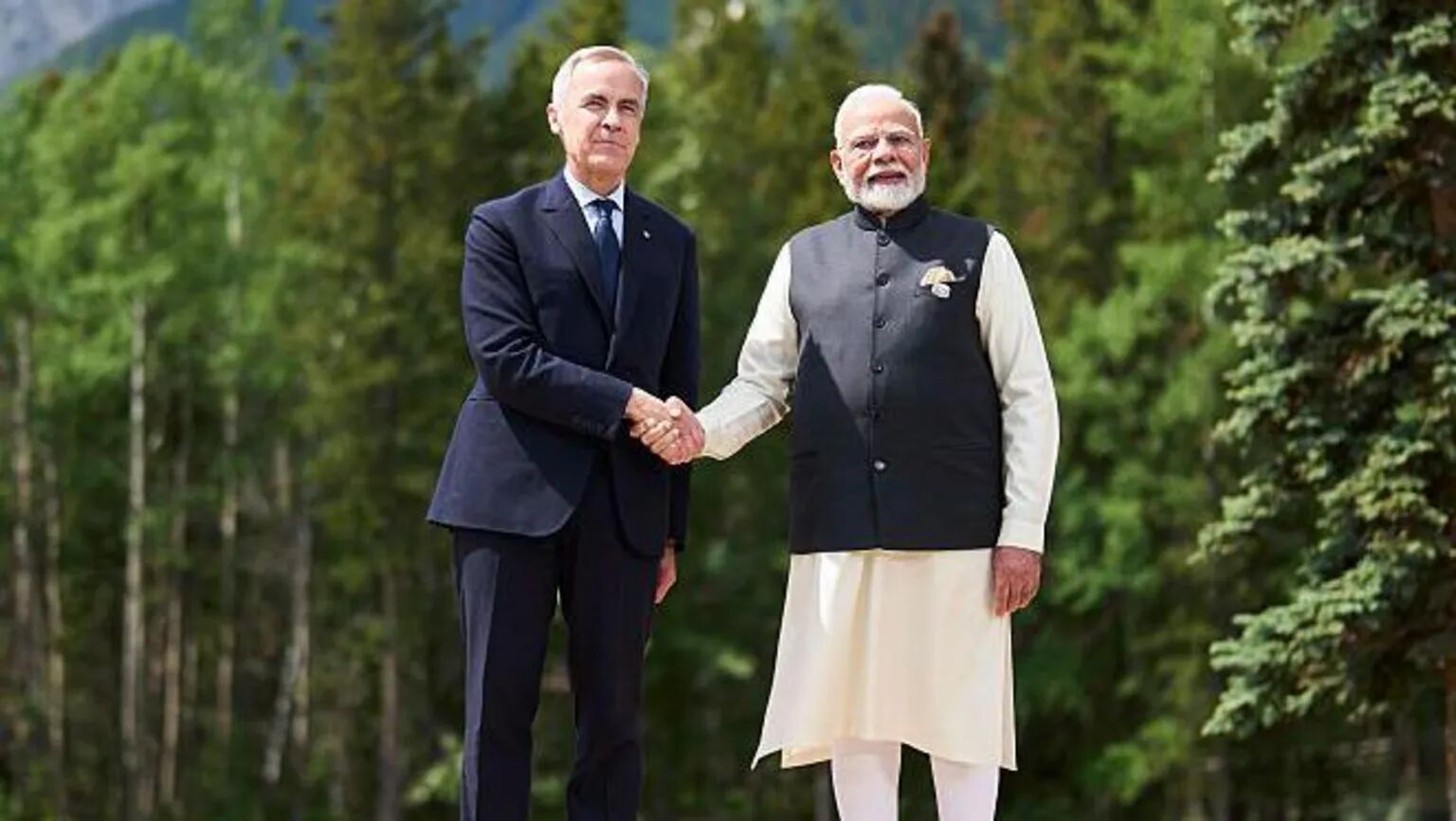
New Delhi, Feburary 28 - When Canadian Prime Minister Mark Carney arrives in India, it is more than a diplomatic visit. It is a test. Over the past two years, relations between Ottawa and New Delhi have fallen to one of their lowest points in decades, shaken by allegations surrounding the killing of Hardeep Singh Nijjar in Surrey and by competing narratives about sovereignty, security and diaspora politics.
For two countries bound by trade, education, a 1.8-million-strong Indian diaspora in Canada, and shared democratic values, the rupture has been both surprising and consequential. The question now is whether the visit signals a genuine reset — and what that reset would require.
The Breaking Point
The diplomatic crisis erupted when former Canadian Prime Minister Justin Trudeau told Parliament that Canadian authorities were investigating “credible allegations” of Indian government involvement in Nijjar’s assassination. India firmly rejected the allegation as “absurd” and “motivated,” accusing Canada instead of providing safe haven to extremist elements advocating for Khalistan — a separatist movement seeking an independent Sikh state in India’s Punjab.
Diplomatic expulsions followed. Trade talks were paused. Intelligence cooperation cooled. Visa services were temporarily disrupted. Public rhetoric on both sides hardened.
From Canada’s perspective, the issue was framed as one of sovereignty and rule of law. Ottawa argued that if a foreign government was involved in violence on Canadian soil, it constituted an unacceptable breach of international norms. Canada emphasized that its legal system must be allowed to investigate freely and transparently.
India’s position was equally firm but rooted in a different concern. New Delhi has long accused segments of the Khalistan movement abroad of promoting extremism and violence. Indian officials argued that Canada had not taken sufficient action against individuals or groups that India designates as extremists. For India, the central issue was national security and territorial integrity.
The Diaspora Factor
The Indian diaspora in Canada — the largest outside India — is both a bridge and, increasingly, a pressure point. Sikhs make up a significant portion of Canada’s political and social fabric, including representation in Parliament and provincial governments.
Canada prides itself on multiculturalism and the right to peaceful protest and expression. India, however, sees certain diaspora activism as crossing into advocacy for secessionism, which it considers a direct threat.
The two positions are not easily reconciled. Canada insists that political advocacy, even if controversial, is protected speech unless it crosses into criminality. India insists that advocacy for Khalistan is not benign political expression but part of a historical insurgency that cost thousands of lives in the 1980s and 1990s.
Bridging this gap will require careful dialogue — and clarity on where freedom of expression ends and incitement begins.
Trade and Strategic Interests
Beyond the political tensions lies a strong economic logic for cooperation. Canada is rich in critical minerals, energy and agricultural exports. India is a fast-growing market with expanding energy needs and a large, young consumer base.
Before the diplomatic freeze, the two countries were negotiating an Early Progress Trade Agreement (EPTA) as a stepping stone toward a comprehensive trade deal. That process stalled.
For Canada, diversifying trade beyond the United States is a strategic priority. For India, access to Canadian energy, potash and investment is valuable. Education is another key pillar: Indian students form one of the largest international student communities in Canada, contributing billions to its economy.
Restoring trade negotiations and stabilizing student mobility would be among the first tangible steps in rebuilding trust.
Security and Intelligence Cooperation
India and Canada have historically cooperated on counter-terrorism and intelligence matters, albeit quietly. The Nijjar case fractured that cooperation.
From India’s standpoint, any reset must include stronger Canadian action against individuals it accuses of extremist activity. From Canada’s side, any cooperation must respect Canadian law and judicial independence.
A possible path forward may involve enhanced intelligence-sharing mechanisms and clearer legal channels for addressing extradition or security concerns. Quiet diplomacy, rather than public accusation, may prove more effective.
Global Context: The Indo-Pacific and China
The timing of this visit is significant. Canada has articulated an Indo-Pacific strategy that seeks deeper engagement with Asian democracies, including India. At the same time, India plays a pivotal role in regional balancing amid tensions with China.
Strategically, both countries have reason to avoid prolonged estrangement. Canada views India as a critical partner in maintaining a rules-based order in the Indo-Pacific. India sees value in partnerships that diversify its global relationships beyond its traditional alignments.
The deterioration in ties also came at a time when both nations face complex relationships with China. A stable India–Canada partnership could enhance economic resilience and strategic coordination in the region.
What Needs to Be Reinstated?
1. Full Diplomatic Engagement
Restoration of high-level dialogue channels is essential. This includes reinstating suspended trade negotiations and regular ministerial visits.
2. Visa and Mobility Stability
Ensuring predictable visa services for students, businesspeople and families would send a strong signal of normalization.
3. Security Dialogue Mechanisms
Structured, confidential channels to discuss security concerns — including diaspora-related tensions — could prevent future public escalations.
4. Economic Confidence
Restarting trade talks and investment discussions would reassure businesses on both sides.
Long-Term Issues to Resolve
1. Defining Boundaries on Diaspora Politics
Both countries must develop a shared understanding of how to manage activism that one side sees as legitimate expression and the other sees as extremist.
2. Judicial Transparency and Due Process
The Nijjar investigation will continue to shape perceptions. Transparent legal processes in Canada, and measured responses from India, will influence long-term trust.
3. Mutual Respect for Sovereignty
Canada insists on protection of its citizens and territory. India insists on respect for its territorial integrity. Reconciling these principles in practice is the core challenge.
4. Public Narrative Management
Heated rhetoric and political posturing amplified the crisis. A more measured tone from leadership on both sides could prevent domestic politics from dictating foreign policy.
A Balanced Path Forward
From Canada’s perspective, standing firm on the rule of law is non-negotiable. From India’s perspective, combating what it sees as separatist extremism is equally non-negotiable. A sustainable reset must acknowledge both realities.
The visit by Prime Minister Carney represents an opportunity to shift the conversation from accusation to architecture — building structures for cooperation that can withstand political storms.
Neither country benefits from a prolonged freeze. Trade suffers. Students face uncertainty. Strategic cooperation weakens. Diaspora communities feel caught between two governments.
The deeper truth is that India and Canada are not adversaries by design. They are democracies with overlapping interests but differing sensitivities. The challenge is not alignment of values — both profess democracy and pluralism — but alignment of expectations.
Resetting this relationship will not happen overnight. It will require political will, diplomatic patience, and a willingness to separate legal processes from geopolitical rivalry.
If handled carefully, this moment of strain could become a turning point — a reminder that even strong partnerships need maintenance, clarity and mutual respect. The visit is a beginning. The real work lies ahead.